The Harness Is the Moat
Published on Nov 16, 2026

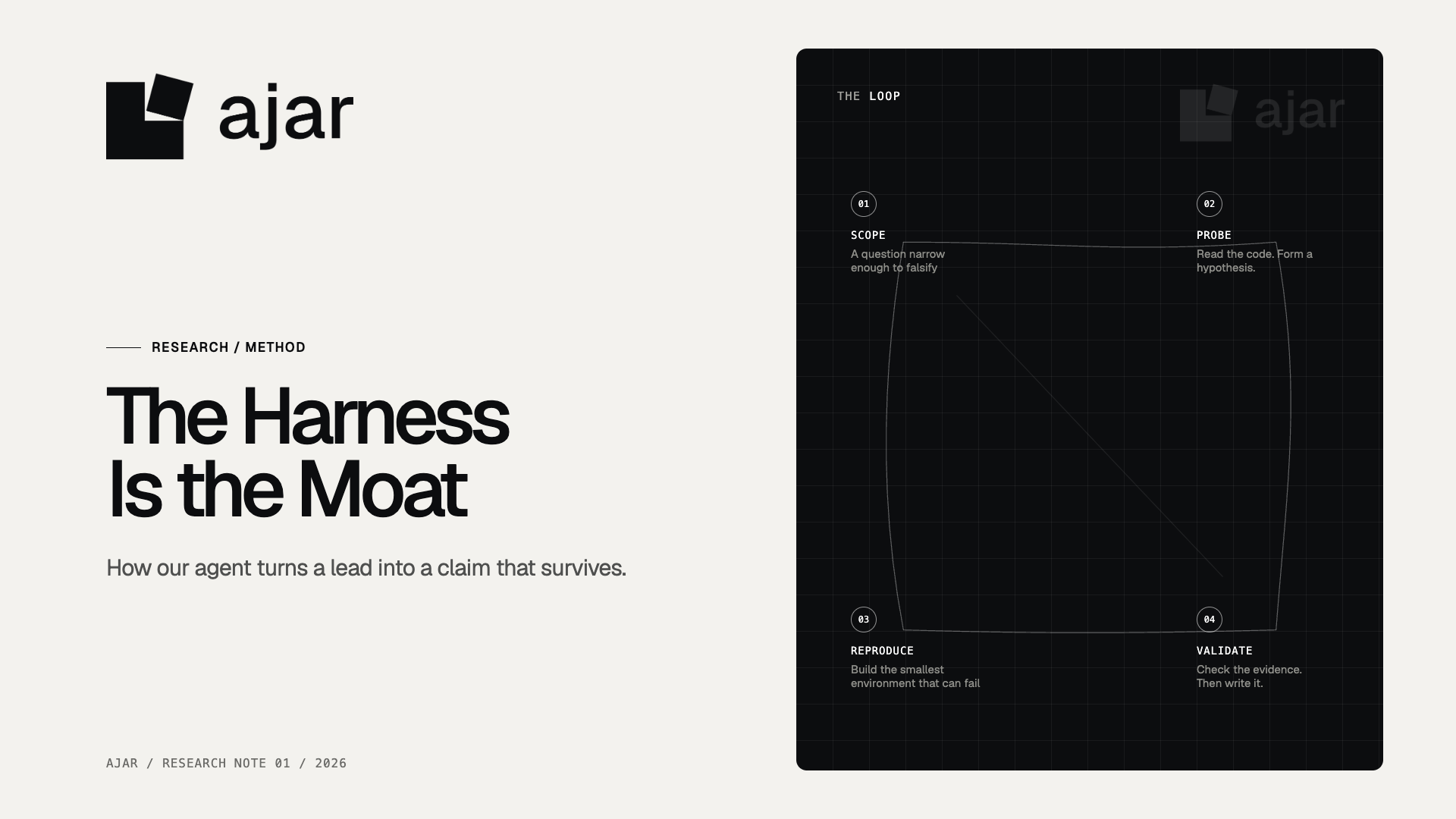
The Klever run produced three crashes. It also produced one claim that we rejected. The rejected claim is the useful part.
Most public agent writeups that we read show the finding. They do not show the claim that failed review. That gap matters. An agent can produce a plausible finding in seconds. It cannot tell you which finding will survive a test.
An agent is a model plus the tools that run it. A harness is the fixed process that tests the agent's output. A harness is not a prompt. It is a set of steps, inputs, gates, and records. The model can change. The record stays.
A claim needs three parts
Every finding needs a claim, a mechanism, and a limit. The claim says what happens. The mechanism says how it happens. The limit says what the test did not show.
"The node crashes" is a headline. It has no mechanism and no limit. A finding is narrower. "A timed-out nested contract leaves a hook goroutine alive. Cleanup frees the Wasmer instance under that goroutine. The node crashes." That sentence has a claim and a mechanism. It still needs a limit.
At Klever, the limit was concrete. All node runs used macOS arm64 and a local chain. We did not test a multi-validator network. That limit did not make the crash less real. It made the claim smaller and more accurate.
The claim card
Before the agent writes prose, it writes a claim card. The card is the unit of work. If the card is empty, the finding does not exist. This is the format we use:
claim:      ...
mechanism:  ...
falsifier:  ...
run:        ...
artifact:   ...
scope:      ...
verdict:    accept | reject | hold
The falsifier is the important field. A falsifier is a result that would prove the claim wrong. The agent must write the falsifier before it builds the reproduction. This order prevents a common failure. An agent can find an explanation after the run. It cannot always predict the result that would prove the claim wrong.
Six gates
The harness applies six gates. A claim must pass all six.
- Scope gate. The target, version, and commit are pinned. A moving target cannot support a claim.
- Reachability gate. The path uses normal inputs. Test hooks and private state do not count.
- Mechanism gate. The source shows the write and the free. A crash alone does not explain a crash.
- Falsifier gate. The claim names a result that would kill it. The run can produce that result.
- Reproduction gate. A second run or a second machine repeats the result. The raw log is kept.
- Boundary gate. The claim states what was not tested. The limit travels with the result.
If a claim fails one gate, it goes back to the agent or leaves the queue. This is the part that most demos skip. The demo shows a candidate. The gates show whether the candidate is a finding.
What the gates rejected
The Klever work produced three claims that did not pass as written. Each rejection changed the claim or the test.
- A nested Wasm worker survives the timeout. Rejected by the reachability gate. Wasmer's breakpoint stopped the worker in about 1 ms. The worker had to run in Go code, or deeper than the breakpointed instance. That correction produced the recursive contract shape.
- One crash can halt the network. Rejected by the boundary gate. We did not run a multi-validator network. We kept the crash mechanism and removed the network claim.
- The flat parent and child shape has a measured crash rate. Held open. The mechanism was clear. The number was not measured.
These are not footnotes. They are the difference between a result and a story.
What the gates accepted
The accepted claim was narrow. A timed-out nested contract can free the Wasmer instance under a live hook worker. The worker then calls through a destroyed pointer and crashes the node.
The harness surfaced the abandoned worker in timeoutWrapper.go, traced the cleanup path, and proposed the recursive contract. It also found the WriteLog gas wrap. The wrap made the timeout cheap. About 19,750 gas bought 3.0 GiB of allocation.
The reproduction crossed the bridge. 15 attack transactions produced 5 timeouts and 3 crashes over 3 cycles. A second machine produced 3 crashes in 3 cycles. A two-node observer setup crashed the non-elected node first in both cycles. The evidence was not a single frame. It was a repeated result with a known limit.
The human stage
People do four tasks. We check the crash frames against the pinned source. We calculate the counts again from the raw logs. We decide which claim the evidence supports. We write the report.
The model can propose. It cannot sign. We do not call this autonomous disclosure. The harness can find a candidate and build a reproduction. Judgment remains with the people who publish the claim.
That work is slower than a demo. It is also the work that makes the demo defensible.
Why this is the moat
"Moat" here means a durable advantage. The model is easy to replace. The test process is not. A faster model gives you more candidates. It does not tell you which candidate is true, which claim is defensible, or which result matters.
The harness is the advantage because it holds the record. The record contains the pinned target, the falsifier, the raw run, the rejected claims, and the limit. Another team can copy the model. It cannot copy the record without doing the work.
What the public work adds
We are not the first team to work this boundary. Public writeups from V12, Tenzai, Veria, NebuSec, Parameter, and Hacktron show the work that closes the gap.
V12 finishes a chain on hardware. Tenzai separates a source lead from exploitability. Veria follows a call graph to a proof forgery. NebuSec writes every constraint. Parameter shows the mess. Hacktron starts with 45 findings and narrows to 24 that a human validated.
Those posts show results. Our addition is the gate record that rejects a result. The public work confirms the problem. It does not supply the harness. We built that, and we keep the rejected claims next to the accepted one.
The model is not the moat. The harness is. A finding is a claim with a mechanism, a run, and a limit. The agent can write the draft. The harness tests it. The human decides what survives.
At Klever, the harness found two bugs and stopped one larger claim. That record is the result. The crashes are the evidence.